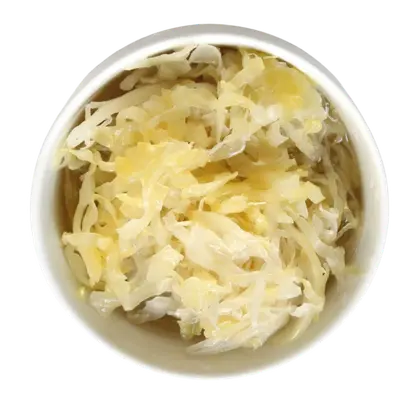
This content is for informational purposes only and does not constitute medical advice. Always consult a qualified healthcare provider before making dietary changes. Histamine tolerance is highly individual.
This information applies to histamine intolerance, DAO deficiency, and MCAS only. If you have a confirmed food allergy, this content does not apply to you. Food allergies involve the immune system and can be life-threatening. Please consult your allergist.
Is Sauerkraut a trigger for histamine intolerance?
Sauerkraut scores a 3 out of 3 on the SIGHI Food Compatibility List, placing it in the High category.
Sauerkraut & Histamine, what the evidence says
Sauerkraut is widely treated as a high-risk food for people with histamine intolerance, and this is well supported by both histamine reference lists and direct measurement. Studies measuring histamine across many commercial and homemade sauerkraut samples have found real variability, with some samples testing quite low and others substantially elevated, depending on the bacteria involved, fermentation conditions, and storage. But the overall picture across these studies is consistently one of concern, not reassurance.
What compounds the problem is that other biogenic amines, particularly tyramine, putrescine, and cadaverine, can accumulate even more substantially during fermentation than histamine itself. Putrescine and cadaverine are also substrates for DAO, an important enzyme involved in breaking down ingested histamine, and laboratory research has found that they can reduce DAO's histamine-degrading activity by 70 to 80 percent at high concentrations. This provides a plausible additional mechanism by which a high-amine food could be more difficult to tolerate, although the extent of this effect after eating sauerkraut has not been established in humans. Sauerkraut's overall concern therefore comes from both its potential histamine content and the mixture of other biogenic amines that can develop during fermentation. Fermentation and storage conditions can substantially change the final amine profile, which is why different batches and products can behave very differently.
Does preparation change the risk?
Most forms of sauerkraut carry a meaningful biogenic amine burden, though the exact profile varies widely by product, fermentation method, and storage time.
| Form | Risk Level | Notes |
|---|---|---|
| Raw / Unpasteurized | High | Contains live bacteria that continue to produce amines over time |
| Pasteurized (canned) | High | Heat stops the bacteria, but amines already formed remain stable |
| Wine-fermented | High | Added alcohol and sulfites tend to further increase the overall amine burden |
| Homemade (short ferment) | Moderate | Levels tend to be lower than long-stored commercial versions, but individual batches vary considerably |
| Sauerkraut juice | High | Concentrated amines in liquid form, with faster systemic absorption |
Note: Risk levels are based on clinical observations and patient reports, not standardized histamine measurements. Individual tolerance varies.
A food score is a reference, not a verdict.
Histamine intolerance is highly individual. A food that triggers symptoms in one person may be tolerated by another, even within the same category.
Strict elimination may help reduce symptoms initially, but long-term progress often depends on gradual reintroduction and pattern recognition. The goal is not to remove more foods over time, but to understand your personal tolerance and expand your diet when possible.
Tracking symptoms, portions, and context such as stress or timing can provide insights that generalized food lists cannot. This is where informed decisions replace fear-based restriction.
How to test your tolerance
 Start with a micro-dose.
If testing tolerance, beginning with half a teaspoon of the juice rather than the fiber can help, since the reaction tends to be dose-dependent.
 Wash and strain.
Rinsing sauerkraut under cold water can reduce some surface-level amines, though it won't eliminate what's absorbed into the cabbage fibers.
 Prioritize fresh cabbage.
If you crave the flavor, fresh, thinly sliced cabbage with a splash of apple cider vinegar can mimic the acidity without the fermentation load.
 Check for additives.
Versions containing juniper berries or wine are worth approaching with more caution, since these add secondary salicylate or sulfite considerations to an already amine-rich food.
- Monitor your overall load.
Eating sauerkraut on a day when you've already had other moderate or higher-risk foods tends to make a cumulative reaction more likely, so it's worth being mindful of combinations.
 Tracking protocol.
Track your response carefully. Note the form, quantity, and timing. Look for patterns across multiple trials using MyHistaMap.
Common questions about Sauerkraut and histamine
Is mild sauerkraut safer for histamine intolerance?
Not necessarily. Even mild flavor profiles usually involve weeks of fermentation, which is generally enough time for biogenic amines to build up, and flavor doesn't reliably indicate amine content.
Does cooking sauerkraut lower the histamine?
Not really. Biogenic amines are heat-stable, so boiling or frying sauerkraut will reduce the probiotics but won't meaningfully lower the amine content already present.
Are the probiotics in sauerkraut worth the reaction?
For someone with DAO deficiency, the discomfort often outweighs the probiotic benefit. Some choose to look for histamine-neutral probiotic strains in supplement form instead.
Why is sauerkraut treated as such a concern, beyond just its histamine content?
Because histamine isn't the only relevant compound, and testing shows real variability from batch to batch. Sauerkraut can also be rich in putrescine and cadaverine, which compete with histamine for the same DAO enzyme, adding to the total amine load the body has to process on top of whatever histamine the specific batch contains.
Some people find these options helpful
Supplements are optional tools, not a solution. Personal tracking and identifying your individual triggers remains the priority.


Where this information comes from
At MyHistaMap we curate information from peer reviewed research and recognized medical sources. This guide is a reference tool, not a medical prescription. Always track your own reactions and consult your healthcare provider.
References
- SIGHI (Swiss Interest Group Histamine Intolerance) Food Compatibility List: lists sauerkraut with a histamine value of 3 (very poorly tolerated, severe symptoms), marked 'H' (rich in histamine). This is the source for sauerkraut's high-histamine classification referenced on this page.
- Concentrations of Seven Biogenic Amines in Sauerkraut, Food Chemistry: measured biogenic amines across 121 sauerkraut samples from Czech and Austrian manufacturers, household preparation, and jarred products, finding histamine below 2 mg/kg in 44% of samples but above 10 mg/kg in 19% of samples, with tyramine, putrescine, and cadaverine present at consistently higher mean concentrations than histamine. This is the source for the histamine variability and amine profile referenced on this page.
- Sánchez-Pérez et al., The Rate of Histamine Degradation by Diamine Oxidase Is Compromised by Other Biogenic Amines, Frontiers in Nutrition, 2022: found in vitro that putrescine and cadaverine significantly delayed DAO's degradation of histamine, reducing it by 70-80% at the highest tested concentration (20-fold higher than histamine), while tyramine, spermidine, and spermine had a smaller effect (32-45% reduction) only at that same highest concentration. This is the source for the DAO competition mechanism referenced on this page.