This content is for informational purposes only and does not constitute medical advice. Always consult a qualified healthcare provider before making dietary changes. Histamine tolerance is highly individual.
This information applies to histamine intolerance, DAO deficiency, and MCAS only. If you have a confirmed food allergy, this content does not apply to you. Food allergies involve the immune system and can be life-threatening. Please consult your allergist.
Is Acerola a trigger for histamine intolerance?
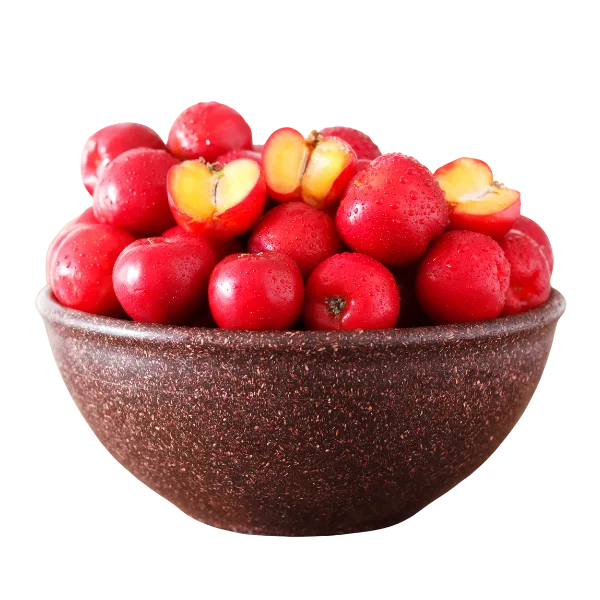
Acerola scores a 0 out of 3 on the SIGHI Food Compatibility List, placing it in the Safe category.
Acerola & Histamine, what the evidence says
Acerola is low in histamine and exceptionally rich in vitamin C. Studies have measured around 1,500 to 4,500 milligrams per 100 grams, far more than an orange contains.
What makes acerola interesting in relation to histamine is this unusually high vitamin C content. In one study, a large IV dose lowered histamine levels in the blood. Another small study gave people up to 4 grams a day by mouth and found no change in how their skin responded to histamine. So the picture isn't as simple as "vitamin C lowers histamine."
The amounts used in these studies were also much higher than what you'd get from a serving of fresh acerola, so the findings can't be applied directly to eating it as a food. The link between vitamin C and histamine is interesting, but how much it matters from food still isn't clear.
Concentrated acerola products can provide very large amounts of vitamin C. High-dose vitamin C supplements have been linked to more oxalate in the urine in some studies, particularly at doses of around 1 gram a day or more. This matters more for concentrated powders or supplements than for ordinary amounts of fresh fruit, especially for people who've had calcium oxalate kidney stones.
Does preparation change the risk?
Acerola itself is rarely a histamine concern. Freshness and how concentrated the product is matter more.
| Form | Risk Level | Notes |
|---|---|---|
| Fresh acerola fruit | Low | Low in histamine, but very perishable, so it's best eaten soon after buying or picking |
| Acerola powder (pure, no additives) | Low | A concentrated source of vitamin C, so serving size matters more than with the fresh fruit |
| Freshly made juice or pulp | Low | Fine when consumed soon after preparation |
| Juice or pulp stored past a day or two | Moderate | Like many soft fruits, it can start breaking down once cut, juiced, or blended |
Note: Risk levels are based on clinical observations and patient reports, not standardized histamine measurements. Individual tolerance varies.
A food score is a reference, not a verdict.
Histamine intolerance is highly individual. A food that triggers symptoms in one person may be tolerated by another, even within the same category.
Strict elimination may help reduce symptoms initially, but long-term progress often depends on gradual reintroduction and pattern recognition. The goal is not to remove more foods over time, but to understand your personal tolerance and expand your diet when possible.
Tracking symptoms, portions, and context such as stress or timing can provide insights that generalized food lists cannot. This is where informed decisions replace fear-based restriction.
How to test your tolerance
 Eat it fresh.
Acerola spoils quickly, so it's best eaten soon after buying or picking.
 Keep juice and pulp cold.
Once acerola is juiced or blended, keep it in the fridge and use it within a day or two.
 Check powder labels.
Some acerola powders include fillers like maltodextrin. They aren't a histamine concern on their own, but they're good to know about if you react to other ingredients.
- Go easy with concentrated powders.
A small scoop of acerola powder can add up to a lot of vitamin C. Many people who've had kidney stones find it helpful to talk with their doctor before using high-dose vitamin C products.
 Keep expectations realistic.
The studies on vitamin C and histamine used much higher doses than a serving of acerola, so eating it isn't a way to lower histamine.
 Track it like any other low-histamine fruit.
Log acerola in MyHistaMap the same way as other well-tolerated fruits and notice how you feel over time.
Common questions about Acerola and histamine
Is acerola high in histamine?
No. Acerola is low in histamine and well tolerated by most people with histamine intolerance.
Does vitamin C lower histamine?
It's not that simple. A large IV dose lowered blood histamine in one study, but another found that up to 4 grams a day by mouth didn't change how the skin responded to histamine. The doses studied were also much higher than what food provides.
Should I take acerola powder for histamine intolerance?
Acerola is a food-based source of vitamin C that many people include in their routine, but it isn't a treatment. Since powders are very concentrated, it's worth keeping portions moderate.
Can acerola raise oxalate levels?
High-dose vitamin C supplements have been linked to more oxalate in the urine, particularly at around 1 gram a day or more. This is more relevant to concentrated powders than to fresh fruit, especially for people who've had kidney stones.
Some people find these options helpful





Supplements are optional tools, not a solution. Personal tracking and identifying your individual triggers remains the priority.
Where this information comes from
At MyHistaMap we curate information from peer reviewed research and recognized medical sources. This guide is a reference tool, not a medical prescription. Always track your own reactions and consult your healthcare provider.
References
- SIGHI (Swiss Interest Group Histamine Intolerance) Food Compatibility List: rates acerola (acerola powder, Barbados cherry, West Indian cherry) 0 (compatible), with no histamine, amine, liberator, or blocker markers. The source for acerola's histamine classification referenced on this page.
- Prakash A, Baskaran R. Acerola, an Untapped Functional Superfruit: A Review on Latest Frontiers. Journal of Food Science and Technology, 2018: reports acerola's ascorbic acid content in the range of 1,500 to 4,500 mg per 100 g, around 50 to 100 times that of orange. The source for the vitamin C figures on this page.
- Hagel AF et al. Intravenous Infusion of Ascorbic Acid Decreases Serum Histamine Concentrations in Patients with Allergic and Non-Allergic Diseases. Naunyn-Schmiedeberg's Archives of Pharmacology, 2013: found a significant decline in serum histamine after a 7.5 g intravenous dose of vitamin C in 89 patients with allergic or infectious diseases. The source for the IV study referenced on this page.
- Fortner BR Jr et al. The Effect of Ascorbic Acid on Cutaneous and Nasal Response to Histamine and Allergen. Journal of Allergy and Clinical Immunology, 1982: in a small controlled study, oral ascorbic acid at doses of up to 4 g per day did not suppress the skin response to histamine. The source for the oral-dose study referenced on this page.
- Baxmann AC et al. Effect of Vitamin C Supplements on Urinary Oxalate and pH in Calcium Stone-Forming Patients. Kidney International, 2003: found that 1 g and 2 g of vitamin C per day increased urinary oxalate in calcium stone-forming patients and in healthy subjects. The source for the oxalate note on this page.