This content is for informational purposes only and does not constitute medical advice. Always consult a qualified healthcare provider before making dietary changes. Histamine tolerance is highly individual.
This information applies to histamine intolerance, DAO deficiency, and MCAS only. If you have a confirmed food allergy, this content does not apply to you. Food allergies involve the immune system and can be life-threatening. Please consult your allergist.
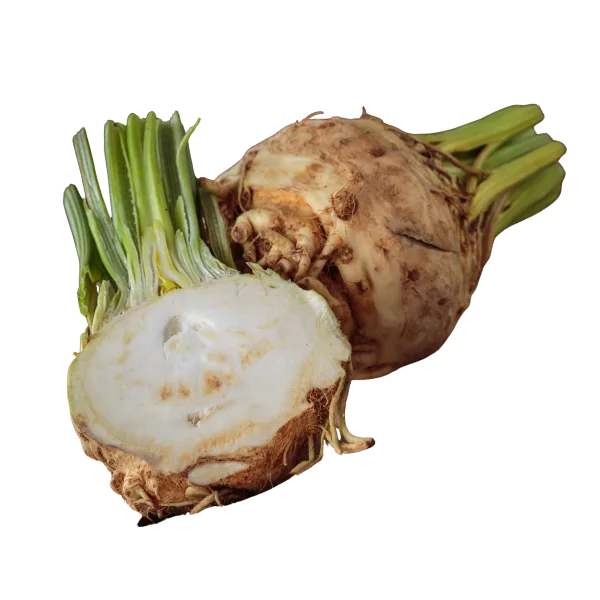
Is Celeriac a trigger for histamine intolerance?
Celeriac scores a 0 out of 3 on the SIGHI Food Compatibility List, placing it in the Safe category.
Celeriac & Histamine, what the evidence says
Celeriac is not associated with meaningful histamine content, which places it favorably on a low-histamine approach. Despite the name and family relationship, celeriac (Apium graveolens var. rapaceum) is a different cultivated variety from stalk celery (Apium graveolens var. dulce), grown for its enlarged root rather than its stalks.
Celeriac is low in oxalate. Its leaves, though rarely used in cooking, contain substantially more polyphenols than the root itself, with one analysis finding roughly eleven times as much. The leaves and root therefore have noticeably different nutritional profiles.
An important separate consideration is celery allergy. Celeriac is part of the celery allergen group and can cause allergic reactions in sensitized individuals, including severe reactions such as anaphylaxis. Celery allergy is also associated with pollen-food cross-reactivity, particularly in people sensitized to birch or mugwort pollen. This is relevant beyond fresh celeriac itself, since celery and celeriac are also used as ingredients in soups, stocks, spice mixtures, and other processed foods.
For people without a celery allergy, celeriac provides fiber and several vitamins and minerals, including vitamin K and vitamin C. Its combination of a low oxalate content and lack of meaningful histamine content makes the root an interesting option for people tracking multiple dietary sensitivities.
Does preparation change the risk?
Celery allergy, not preparation method, is the most important variable for celeriac.
| Form | Risk Level | Notes |
|---|---|---|
| Raw or cooked root, no known celery allergy | Low | Not associated with meaningful histamine content; low in oxalate |
| Any form, known celery allergy | High | Can cause reactions ranging from mild to severe anaphylaxis; avoid entirely |
| Hidden in soups, stocks, or spice mixtures | Moderate | Worth checking ingredient labels if you have a celery allergy or are sensitized to birch or mugwort pollen |
Note: Risk levels are based on clinical observations and patient reports, not standardized histamine measurements. Individual tolerance varies.
A food score is a reference, not a verdict.
Histamine intolerance is highly individual. A food that triggers symptoms in one person may be tolerated by another, even within the same category.
Strict elimination may help reduce symptoms initially, but long-term progress often depends on gradual reintroduction and pattern recognition. The goal is not to remove more foods over time, but to understand your personal tolerance and expand your diet when possible.
Tracking symptoms, portions, and context such as stress or timing can provide insights that generalized food lists cannot. This is where informed decisions replace fear-based restriction.
How to test your tolerance
 Know about celery allergy first.
Celeriac is part of the celery allergen group and can cause reactions ranging from mild to severe anaphylaxis in sensitized individuals. This is a separate and more urgent consideration than histamine.
 Relevant if you have birch or mugwort pollen allergies.
Celery allergy is associated with pollen-food cross-reactivity, particularly in people sensitized to birch or mugwort pollen.
 Check labels on soups, stocks, and spice mixtures.
Celery and celeriac are commonly used as ingredients in processed foods, relevant for anyone with a celery allergy.
- The leaves and root differ nutritionally.
Celeriac leaves, though rarely used in cooking, contain roughly eleven times more polyphenols than the root, according to one analysis.
 Track your response if trying it new.
For those without a celery allergy, celeriac is a reasonable food to test given its low-histamine, low-oxalate profile. Log your experience with the MyHistaMap app.
Common questions about Celeriac and histamine
Is celeriac high in histamine?
No. Celeriac is not associated with meaningful histamine content.
Is celeriac the same as celery?
They're closely related but different cultivated varieties of the same species: celeriac is grown for its enlarged root, while stalk celery is grown for its stalks.
Can celeriac cause an allergic reaction?
Yes. Celeriac is part of the celery allergen group and can cause reactions ranging from mild to severe anaphylaxis in sensitized individuals, particularly those sensitized to birch or mugwort pollen.
Is celeriac high in oxalate?
No, it's low in oxalate.
Do celeriac leaves have the same nutritional profile as the root?
No. Celeriac leaves contain substantially more polyphenols than the root, roughly eleven times as much according to one analysis, though the leaves are rarely used in cooking.
Some people find these options helpful





Supplements are optional tools, not a solution. Personal tracking and identifying your individual triggers remains the priority.
Where this information comes from
At MyHistaMap we curate information from peer reviewed research and recognized medical sources. This guide is a reference tool, not a medical prescription. Always track your own reactions and consult your healthcare provider.
References
- SIGHI (Swiss Interest Group Histamine Intolerance) Food Compatibility List, version 2024-08-29: rates turnip-rooted celery (celeriac) 0, with no liberator or rich-in-histamine marking. This is the source for the low-histamine classification referenced on this page.
- Celeriac Oxalate Content, OxalateContent.com, citing USDA FoodData Central: reports oxalate content of celeriac at 7mg per 100g, considered low in oxalates.
- Celeriac: Calories & Nutritional Value, Aprifel, citing Kulig 2019: reports that celeriac leaves contain 11 times higher amounts of polyphenols than the root. This is the source for the leaf-versus-root polyphenol comparison referenced on this page.
- New Insights on Celery Allergies and Associated Risks, Paul-Ehrlich-Institut, 2024: reports a clinical study of 79 patients with confirmed celery root allergy in which 49 had systemic reactions, with 68% showing IgE to celery extract, 80% to birch pollen, and 77% to mugwort pollen, identifying the defensin Api g 7 as a key cross-reactive allergen associated with severe reactions in mugwort-sensitized patients. This is the source for the celery allergy and pollen cross-reactivity information referenced on this page.
- IgE Cross-Reactivity Between Birch Pollen, Mugwort Pollen and Celery is Due to at Least Three Distinct Cross-Reacting Allergens, PubMed: established what is now known as birch-mugwort-celery syndrome, identifying shared cross-reacting proteins between birch pollen, mugwort pollen, and celery.